






We often overlook it in the convenience of our daily routines: a quick tap on a smartphone to order a Friday night dinner, or summoning a ride to the airport. It feels like a seamless local transaction. But beneath the surface of this convenience lies a harsh economic reality. Every time you order from a major delivery or ride-hailing app, a significant percentage of that money—wealth generated within your community—quietly leaves your local economy.
For years, the narrative of the "sharing economy" promised empowerment for local merchants and independent drivers. However, as global tech giants have consolidated power, the reality has shifted. It is time to uncover the hidden commissions draining our local economies and explore why building a localized digital ecosystem is the most critical step for regional commerce today.
1. The Heavy Toll of the "Invisible Tax"
To understand the scale of the problem, we must look at the numbers. The business model of major multi-national "Super Apps" relies heavily on extracting value from both ends of the transaction: the service provider and the workforce.
The Squeeze on Local Merchants
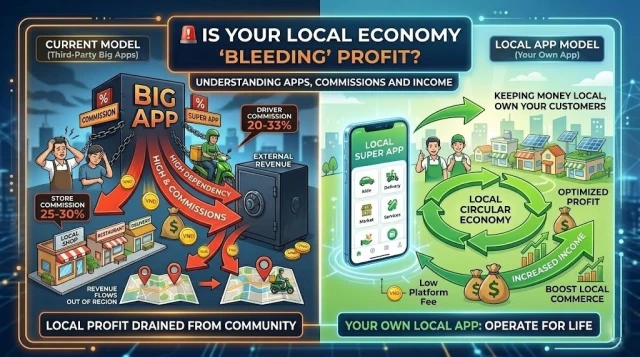
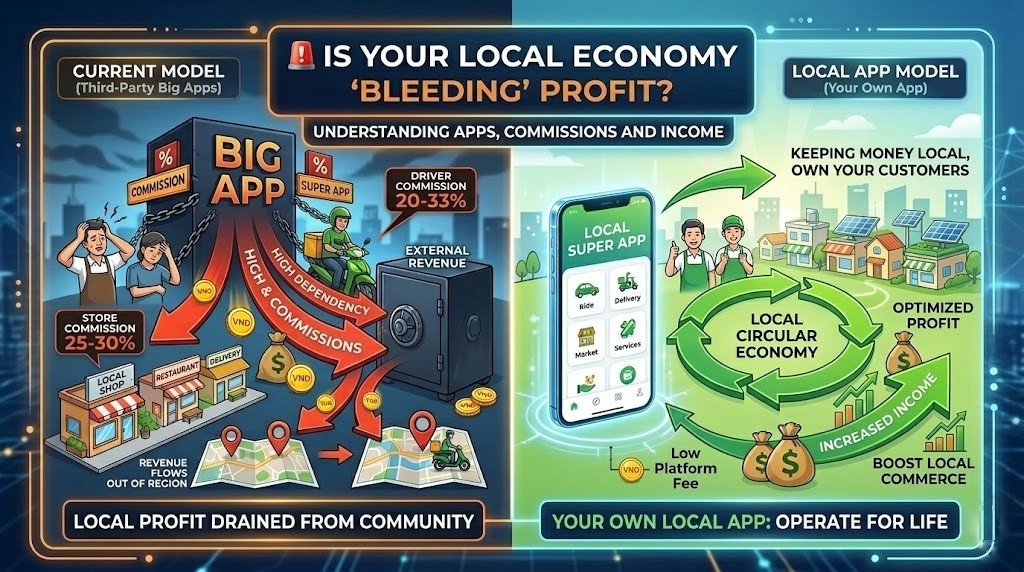
Large platforms typically charge restaurants, cafes, and local shops up to 25% to 30% in commissions on every single order. In the food and beverage industry, where profit margins are notoriously thin (often hovering around 10% to 15%), a 30% cut doesn't just eat into profits—it often consumes them entirely. To survive, local business owners are forced into a difficult corner: they must either raise prices for the end consumer or compromise on the quality of their offerings.
The Burden on the Gig Workforce
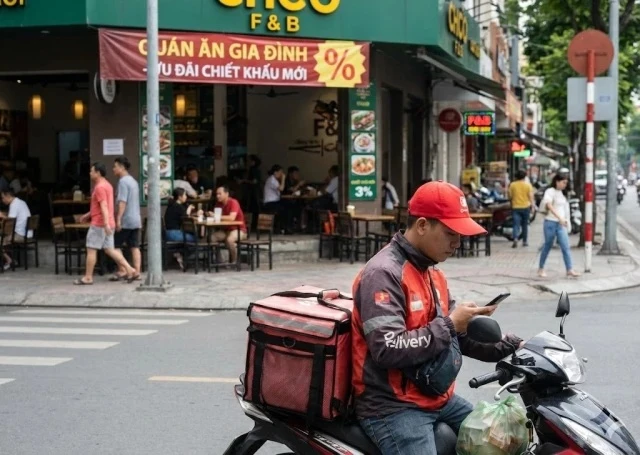
The situation is equally challenging for the individuals powering these platforms. Major apps often take around 20% to 33% from the income of drivers and delivery workers. When factoring in the rising costs of fuel, vehicle maintenance, and insurance, an independent driver might see an unacceptable amount of their hard-earned money siphoned off.
Ultimately, the money isn’t staying in your town. It is bypassing the local ecosystem and flowing directly into the corporate treasuries of big tech companies.
2. The Inherently Local Nature of Services
The irony of this massive wealth extraction is that the core services being provided are inherently local operations.
Think about the mechanics of a food delivery or a ride-hailing request:
- The driver lives in your city.
- The restaurant sources ingredients from regional suppliers.
- The customer is a resident of the same community.
- The wear and tear happen on local roads.
These services are about local people serving local customers with local products. They were originally meant to boost local commerce, create regional wealth, and provide sustainable income. The technology platform acts merely as a digital matchmaker. Yet, because a few external third parties control the matchmaking algorithms, they command an outsized share of the revenue. The local economy takes on all the physical work and infrastructure strain, while the platform reaps the financial reward.
3. It’s Time for Your Own Local Multi-Service "Super App"
The solution to this economic drain is not to abandon technology, but to democratize it. Regions, provinces, and local business alliances must reclaim their digital real estate by establishing a dedicated, localized multi-service "Super App."
Transitioning from external dependency to an internalized platform offers incredible, long-lasting value:
- Maximum Capital Retention: By setting fair, sustainable platform fees, a local app optimizes profit margins for mom-and-pop shops and significantly increases the take-home pay for workers. This retained wealth creates a robust local circular economy, where money is spent, saved, and reinvested within the community.
- Total Ownership of Data and Customers: On big platforms, businesses are simply tenants; they do not own their customer data. A localized app allows regional businesses to directly own their customer relationships, build loyalty programs, and analyze data to serve their community better, drastically reducing external platform dependency.
- Deep Regional Specialization: A global app looks the same everywhere. A local Super App can be fully customized to promote unique regional products, integrate deeply with local tourism initiatives, and highlight specialty services that massive, generalized apps simply ignore.
4. Shattering the Technology Barrier
For a long time, the desire to build a local platform was halted by a massive roadblock: the technology itself.
Historically, launching a comprehensive multi-service app—one that seamlessly integrates ride-hailing, food delivery, local e-commerce, and facility booking—was viewed as an impossible task for local entities. It required millions of dollars in upfront capital, a large team of specialized software developers, and the daunting task of managing complex server infrastructures and routing algorithms.
🚀 Today, that technology barrier is entirely gone.
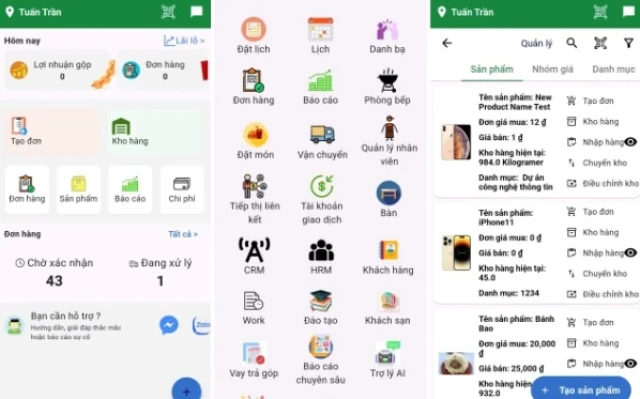
Through advanced Software-as-a-Service (SaaS) models, platforms now exist that can build, customize, and deploy a fully-featured, branded Local Super App in a matter of days.
This is where infrastructure solutions like ODSBase step in to redefine the game. By providing a ready-made, highly scalable technological backbone, ODSBase allows local enterprises to bypass the arduous development phase. More importantly, this model handles the heavy lifting of long-term technical operations, server maintenance, and system upgrades for life.
You no longer need an in-house IT empire to compete digitally. You simply need the vision to unite your local market.
5. Stop "Building on Someone Else’s Land"
Digital real estate is the most valuable asset of the 21st-century economy. Every day your local businesses operate exclusively through third-party platforms, they are paying astronomical rent to build their businesses on someone else’s land.
It is time to change the paradigm. It is time for your region to own its digital platform, protect its workforce, and aggressively build regional wealth. The tools are here, the economic imperative is clear, and the power to create a thriving, self-sustaining local ecosystem is finally back in your hands.
Is your local business community ready to discuss this transformation? Let's talk.
#LocalEconomy #DigitalTransformation #SuperApp #TechInov #RegionalCommerce #CircularEconomy #LocalBusiness #ODSBase #Di4L
Random Posts